Understanding Biblical Genres
Learning to Read Different Types of Scripture
One of the most important principles of Bible study is understanding that the Bible contains different types of literature. These different forms of writing are often called genres.
Just as we read a newspaper differently than a poem or a history book differently than a letter, we must read different parts of the Bible according to the type of writing God used to communicate His truth.
Understanding biblical genres helps us interpret Scripture accurately, appreciate its richness, and avoid misunderstandings. God inspired every part of Scripture, but He used many different writers, styles, and literary forms to communicate His message.
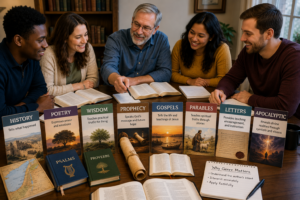
Understanding the Different Types of Writing in the Bible
What Is a Biblical Genre?
A genre is a category or type of literature.
The Bible contains history, poetry, wisdom literature, prophecy, letters, biographies, apocalyptic visions, parables, and more.
Each genre communicates truth in a slightly different way.
Understanding the genre of a passage helps us determine how it should be read and interpreted.
Genre does not affect whether Scripture is true. Rather, it helps us understand how God chose to communicate that truth.
Historical Narrative
Much of the Bible is written as historical narrative.
Historical narratives tell the story of God’s work through people and events.
Examples include:
Genesis
Exodus
Joshua
Judges
1 and 2 Samuel
1 and 2 Kings
Acts
Historical narratives describe what happened. They show God’s faithfulness, human obedience and failure, and God’s ongoing plan of redemption.
When reading narrative passages, pay attention to the story, the characters, and what the passage reveals about God.
Poetry
Poetry is found throughout the Bible.
Biblical poetry often uses imagery, symbolism, repetition, comparison, and vivid language.
Examples include:
Psalms
Much of Proverbs
Song of Solomon
Many sections of the Prophets
Poetry is designed to stir the heart, express worship, communicate wisdom, and help us see spiritual truths through pictures and imagery.
Not every poetic statement is intended to be interpreted literally.
Wisdom Literature
Wisdom literature teaches practical truths about life, relationships, work, faith, and godly living.
Examples include:
Proverbs
Ecclesiastes
Job
Wisdom literature often presents general principles rather than absolute guarantees.
These books help believers learn how to live wisely before God.
Prophecy
The prophets were God’s messengers to His people.
Prophetic books include:
Isaiah
Jeremiah
Ezekiel
Daniel
The Minor Prophets
Prophecy often contains warnings, calls to repentance, promises of restoration, and predictions concerning future events.
Some prophecies were fulfilled shortly after they were given. Others point to Jesus Christ, the church, or future events that are still unfolding.
The Gospels
Matthew, Mark, Luke, and John are known as the Gospels.
These books tell the story of Jesus Christ.
They include historical events, teachings, miracles, parables, and accounts of Jesus’ death and resurrection.
The Gospels help us understand who Jesus is and what He came to accomplish.
They form the foundation of Christian faith and discipleship.
Parables
Parables are short stories used to teach spiritual truths.
Jesus frequently taught through parables.
Examples include:
The Good Samaritan
The Prodigal Son
The Sower
The Lost Sheep
Parables usually focus on one primary lesson rather than every detail carrying a hidden meaning.
Understanding the main point of the story is often the key to understanding the parable.
Letters and Epistles
The New Testament contains letters written to churches and individuals.
Examples include:
Romans
1 and 2 Corinthians
Galatians
Ephesians
Philippians
James
1 Peter
These letters address real situations faced by early Christians.
They provide teaching, encouragement, correction, and guidance for Christian living.
Understanding the original audience and circumstances is especially important when studying these books.
Apocalyptic Literature
Apocalyptic literature uses symbols, visions, images, and dramatic language to reveal spiritual realities and God’s ultimate victory.
Examples include:
Parts of Daniel
Revelation
Apocalyptic writings often contain symbolic imagery that points beyond the literal picture being described.
Understanding historical context and symbolism is particularly important when studying these passages.
Why Genre Matters
Understanding genre helps us avoid confusion.
We should not read poetry exactly like history.
We should not interpret a parable exactly like a legal instruction.
We should not approach symbolic visions in the same way we approach a historical narrative.
Recognizing genre helps us understand what the biblical author intended to communicate.
Reading Each Genre Faithfully
As we study Scripture, we should ask:
What type of writing is this?
How does this genre communicate truth?
What would the original audience have understood?
How does this fit within the larger story of Scripture?
These questions help us become better students of God’s Word.
Genre and the Story of the Bible
Although the Bible contains many genres, it tells one unified story.
From Genesis to Revelation, Scripture reveals God’s creation, humanity’s fall into sin, God’s plan of redemption, the coming of Jesus Christ, the growth of the church, and the promise of God’s eternal kingdom.
Understanding genre helps us appreciate the many ways God communicates this one great story.
Why This Matters
God inspired every book of the Bible.
Understanding biblical genres helps us read Scripture more carefully, interpret it more accurately, and apply it more faithfully.
The more we understand how God communicates through different types of writing, the more clearly we can hear His voice through His Word.
Related Pages
Understanding the Context of Scripture
Understanding How the Bible Is Organized
Old Testament and New Testament
Major Themes of the Bible
Understanding Old Testament History
Understanding the New Testament World
Continue Learning
Understanding the Context of Scripture
Major Themes of the Bible
Understanding Old Testament History
Understanding the New Testament World


