Biblical Geography
Understanding the Places Where the Bible Happened
The Bible is not simply a collection of teachings and stories. It is the record of God’s work through real people living in real places throughout history.
Mountains, rivers, deserts, seas, villages, cities, kingdoms, and nations all played important roles in the biblical story. Understanding biblical geography helps us better understand the events of Scripture and the journeys of God’s people.
Geography influenced travel, trade, agriculture, warfare, worship, and daily life. It shaped the experiences of Abraham, Moses, David, the prophets, Jesus, the apostles, and the early church.
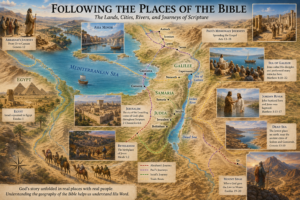
Following the Places of the Bible
Why Biblical Geography Matters
Many biblical events make more sense when we understand where they occurred.
Geography helps explain:
Travel routes
Military conflicts
Trade and commerce
Cultural interactions
Jesus’ ministry journeys
Missionary journeys of the apostles
The spread of the gospel
The physical setting often helps us understand the meaning and significance of biblical events.
The Ancient Near East
Much of the Bible takes place within a region known as the Ancient Near East.
Important areas include:
Mesopotamia
Egypt
Canaan
Israel
Judah
Assyria
Babylon
Persia
These lands served as the backdrop for many of the major events of the Old Testament.
The Promised Land
The Promised Land occupies a central place in biblical history.
God promised this land to Abraham and his descendants.
The land became the home of Israel and the setting for much of the Old Testament story.
Its location connected Africa, Asia, and Europe, making it an important crossroads for travel and trade.
Major Regions of Israel
Several regions appear frequently throughout Scripture.
Galilee
Samaria
Judea
Perea
The Decapolis
Each region had its own culture, history, and significance.
Understanding these regions helps us follow the ministry of Jesus and the growth of the early church.
Jerusalem
Jerusalem is the most important city in the Bible.
It became the capital city under King David.
Solomon built the Temple there.
The prophets ministered there.
Jesus taught there, was crucified there, and rose again near the city.
The early church was born there on the Day of Pentecost.
Jerusalem stands at the center of much of biblical history.
Bethlehem
Bethlehem was the hometown of King David.
It became famous as the birthplace of Jesus Christ.
Though small in size, Bethlehem occupies an important place in God’s redemptive story.
Nazareth
Nazareth was the town where Jesus grew up.
Located in Galilee, it was a relatively small village during the first century.
Much of Jesus’ early life was spent there before He began His public ministry.
The Sea of Galilee
The Sea of Galilee played a major role in the ministry of Jesus.
Many of His disciples were fishermen who worked on its waters.
Jesus taught, performed miracles, calmed storms, walked on water, and called disciples along its shores.
Many Gospel events occurred in villages surrounding the Sea of Galilee.
The Jordan River
The Jordan River flows through much of biblical history.
Israel crossed the Jordan when entering the Promised Land.
John the Baptist baptized people there.
Jesus Himself was baptized in the Jordan River.
The river became a symbol of God’s provision, promise, and new beginnings.
The Dead Sea
The Dead Sea lies southeast of Jerusalem.
It is one of the saltiest bodies of water in the world.
The region surrounding it is associated with several important biblical events and locations.
The Wilderness
The wilderness appears throughout Scripture.
Israel wandered in the wilderness for forty years.
Prophets often spent time there.
John the Baptist preached there.
Jesus was tempted in the wilderness before beginning His ministry.
The wilderness often symbolizes testing, dependence upon God, and spiritual preparation.
Mountains in the Bible
Mountains frequently serve as places of encounter with God.
Mount Ararat
Mount Sinai
Mount Carmel
Mount Zion
Mount of Olives
Important events involving worship, covenant, prayer, and revelation often occurred on mountains.
Roads and Travel
Travel in biblical times was often difficult.
People commonly traveled by foot, donkey, camel, or boat.
Important roads connected cities, regions, and nations.
Roman roads later helped spread Christianity throughout the empire.
Understanding these travel routes helps us follow biblical journeys and missionary efforts.
Paul’s Missionary Journeys
Geography becomes especially important in the Book of Acts.
Paul traveled throughout:
Asia Minor
Greece
Macedonia
Cyprus
Rome
His journeys helped spread the gospel throughout the Roman world.
Understanding these locations helps readers follow the growth of the early church.
Geography and the Story of Jesus
The ministry of Jesus unfolded across many locations.
Nazareth
Cana
Capernaum
Bethlehem
Jerusalem
Bethany
The Jordan River
The Sea of Galilee
Each location contributes to the story of His life, ministry, death, and resurrection.
Geography and God’s Plan
Biblical geography is more than a collection of maps and locations.
God worked through real places and historical settings to accomplish His purposes.
The lands of the Bible help us understand how God’s promises unfolded throughout history.
Why This Matters
Understanding biblical geography helps us visualize Scripture and place biblical events within their historical setting.
The better we understand the places of the Bible, the more clearly we can follow God’s story from Genesis to Revelation.
Biblical geography reminds us that God’s work in history occurred in real places among real people and continues to impact lives today.
Related Pages
Understanding the Biblical World
Understanding the Old Testament World
Understanding the New Testament World
Understanding Old Testament History
Learn the Story of God and the Old Testament
Continue Learning
Understanding the Old Testament World
Understanding the New Testament World


